Enterprise

Change your platform without rebuilding your platform.

Your data, your components, your pages — independent by design.

SnowBlock separates how your content is structured, how it is rendered, and how pages are composed — so you can replace one layer without rebuilding the other two.

  • Talk to an engineer, not a sales rep
  • Bring your architect
  • We will answer the hard questions

Built for

  • B2B commerceManufacturing, distribution, wholesale
  • B2C brandsRetail, CPG, media, hospitality
  • GovernmentState, city and municipal
  • Service providersAgencies building for many clients
  • Multi-brand groupsMany sites, markets and languages

And organisations that are several of these at once.

Architecture

Three layers. One clear boundary between them.

SnowBlock separates content, components and page composition. That means each layer can evolve without forcing the others to move with it.

Define what your content is, separately from how it looks.

Create the types your business actually has — Article, Product, Location, Vehicle — with their own fields, rules and relationships. One schema can carry thousands of instances, and changing it changes them all.

What you get

  • Types and schemas you define, with typed fields and relationships
  • Content instances against those schemas
  • Validation at the contract, not only at the form
  • Schemas generate TypeScript types at build

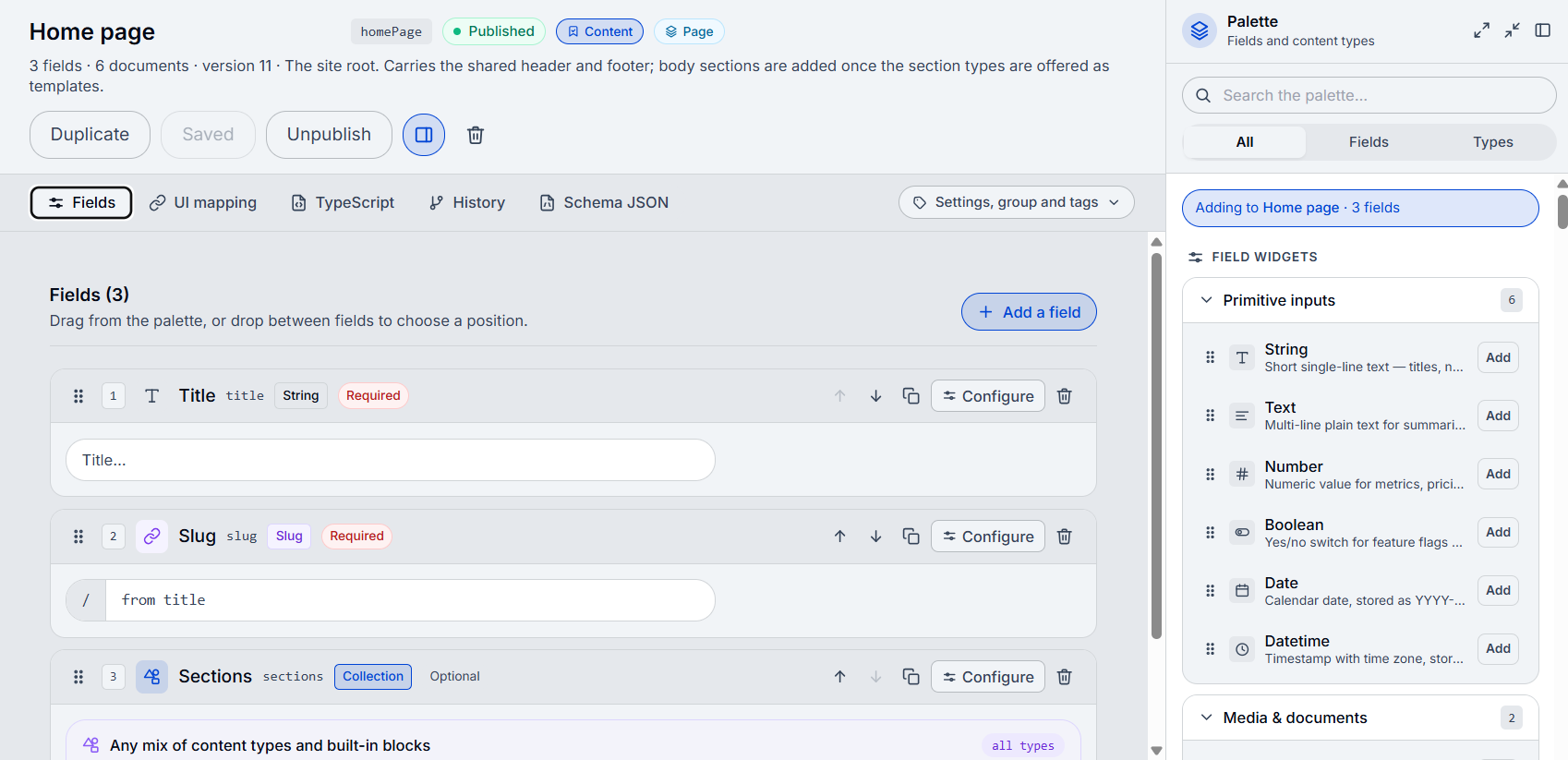
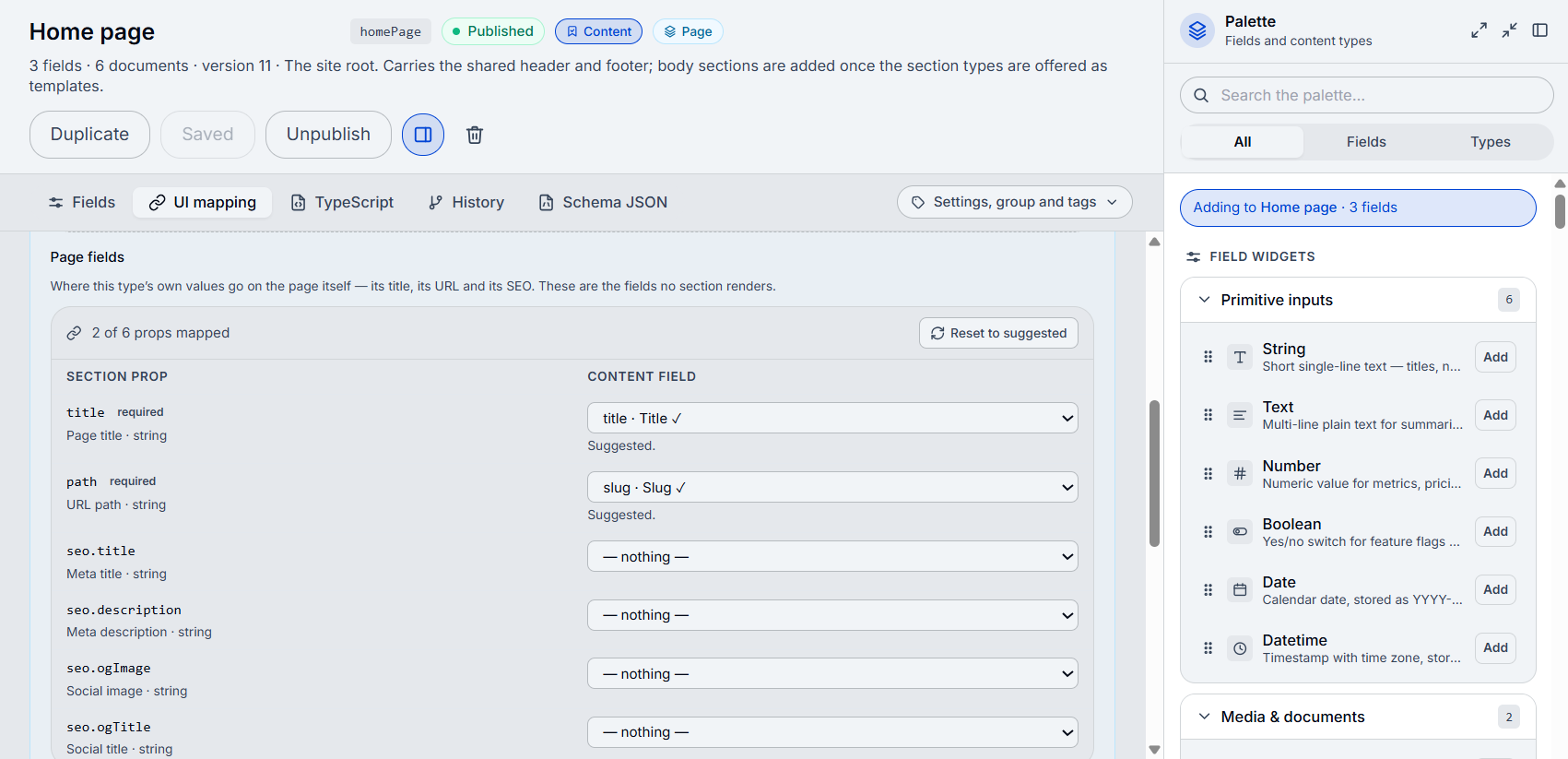
SnowBlock Studio — Content types
A content type in the Studio, showing its fields, their types and which are required

Many platforms call themselves headless because content comes out of an API. Here the boundaries between the three layers are real — and you can cut at any of them.

What we ship above the cut. What you can bring instead, below it.

Data
Our MongoDB
Your REST or GraphQL API
Components
Our component library
Your design system
Presentation
Our renderer
Your app, kiosk or feed

Independence

Replace one layer without replacing everything.

One case per layer.

Replaces the Data layer.

Keep your systems of record

Your product data lives in SAP, your articles in a content system you already run, your locations somewhere nobody wants to touch. Connect to them instead of moving everything.

Components and pages keep working against the same contracts.

Replaces the Components layer.

Keep your design system

You already have a design system, audited and paid for. Register those components instead of rebuilding them.

Its accessibility work and brand rules come with it.

Replaces the Presentation layer.

Keep your content, change the channel

Render structured content yourself — a native app, a kiosk, a partner feed, a framework we do not ship.

Data and mapping work without our presentation layer at all.

Most teams never swap a layer on day one. The point is that doing it in year three is a project, not a migration.

When your digital estate gets complicated, your architecture matters.

The underlying architecture stays the same. The problems it solves depend on how your organisation operates.

Multi-brand & multi-market

You did not set out to run forty websites. They accumulated — and now nobody can say how many exist, or whether they follow the same standards.

  • One component library across brands and markets
  • Brand tokens layered as platform baseline → brand → market override
  • Shared component fixes apply everywhere that component is used
  • Content types shared; content instances isolated per tenant
  • Per-language URLs and content

Two hundred sites is two hundred accessibility liabilities. A shared component library makes it one.

Governance

Give teams freedom inside boundaries you control.

Enterprise governance works best when the system enforces the rules instead of relying on a policy document alone.

  • one definition

    One registry, three consumers

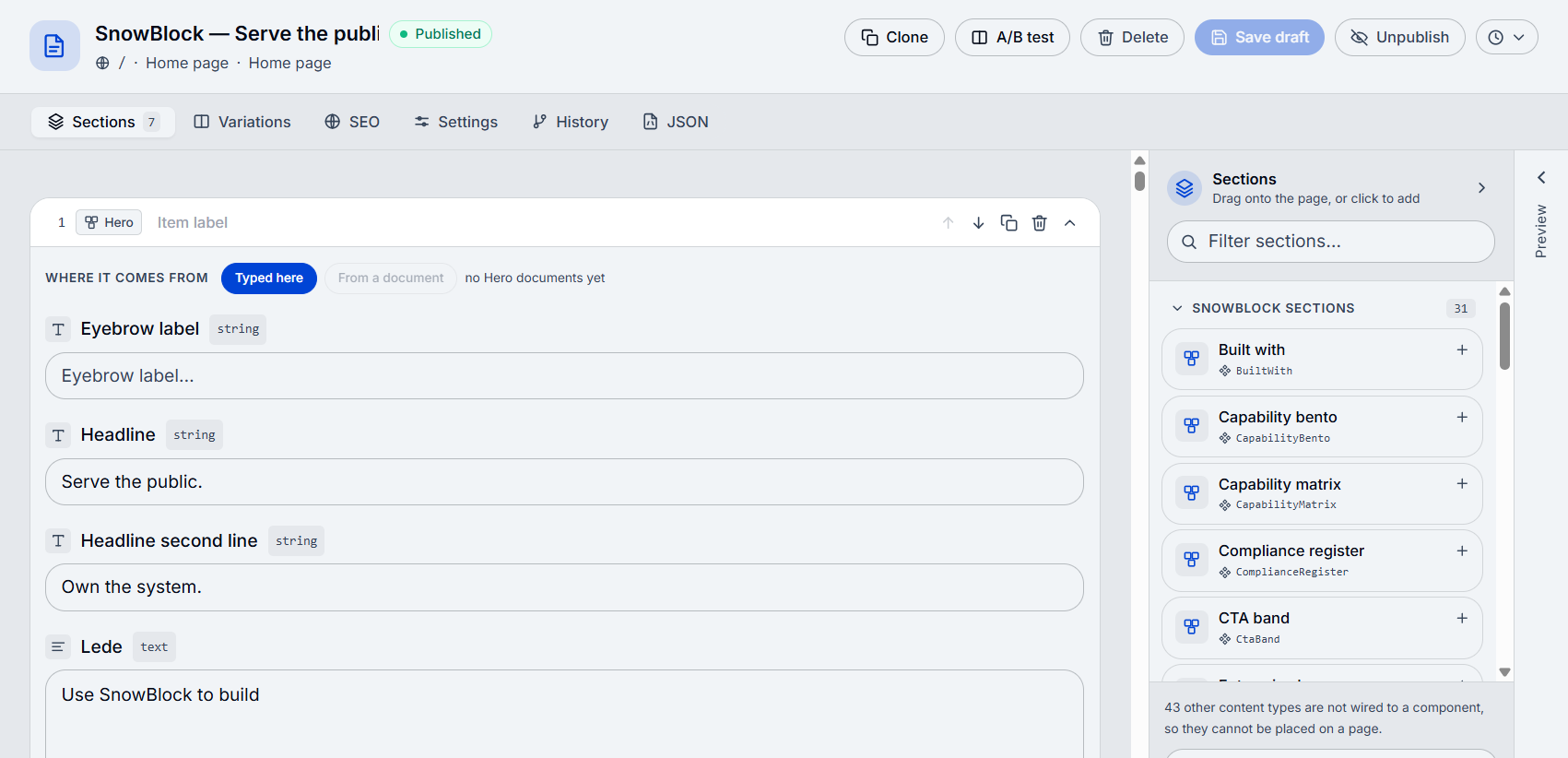
    The components your site renders, the ones preview shows and the ones the editor offers all come from a single definition. There is no second list to maintain separately.

  • signed RPC

    Publishing is signed

    Every publish is a signed RPC against a per-tenant keypair. Cache invalidation is an HMAC-verified webhook. A publish that did not come from the tenant does not happen.

  • sha384 SRI

    Remote components are integrity-checked

    Federated component bundles ship with Subresource Integrity hashes. A modified bundle does not execute.

  • JSON Schema

    Contracts are checked at build

    Component schemas generate TypeScript prop types during the build. A component that drifts from its schema surfaces as a type error rather than a runtime failure.

  • base → tenant → editor

    Themes layer, they do not overwrite

    Editors change what you allow them to change. The baseline underneath stays yours.

  • SSO · RBAC · audit

    Access and audit

    SSO, role-based access, audit logs, separate environments, self-hosting and private-region deployment.

You keep what you build.

SnowBlock is built around standards and code you control. Your components stay in your repository. Your schemas stay portable. Your content stays structured.

What you keep

  • React

    Your components stay yours

    Your components are ordinary React code in your repository. They are not tied to a proprietary template language, so they remain part of your codebase whether you stay with SnowBlock or not.

  • JSON Schema

    Your content model stays portable

    Your content types are defined using JSON Schema, not a SnowBlock-specific format. The schema remains usable outside SnowBlock and can move with your architecture.

  • Structured export

    Your content stays content

    Export your schemas and content as structured data that preserves the underlying model. You do not have to reconstruct your content from rendered HTML.

Start without moving everything

  1. Model the content first

    Get the model right before you migrate

    Define your types, fields and relationships before moving pages. Your content model becomes the contract between your data and the experience built on top of it.

  2. Move in slices

    Migrate without the big bang

    Move a section, template or site at a time. Because the layers are independent, a partial migration remains a working system rather than becoming a half-finished rebuild.

  3. Keep what already works

    Migration does not mean moving everything

    If your product data belongs in your PIM, keep it there where supported. If another system already does its job well, SnowBlock does not require you to replace it just to adopt the platform.

Stay because SnowBlock earns its place, not because your architecture depends on it.

Keep what works.
Change what doesn't.

Bring your current architecture, data model, and integrations. We'll show you where SnowBlock fits, what can stay in place, and what you can replace without rebuilding everything around it.

  • Engineer on every call
  • No obligation
  • Straight answers